
Electricity Forum Electricity Today Magazine Arc Flash Training

Electric Motors


Enhance Performance with VFD Technology

Energy savings for pumping applications BY TOM NEUBERGER & STEVEN WESTON, Eaton In the early days of variable frequency drive (VFD) technology, the typical application was in process control for manufacturing synthetic fiber, steel bars and aluminum foil. Because VFD improved process...

Monitoring Stator Winding Deterioration

The importance of partial discharge testing in electric motors BY VICKI WARREN, Iris Power LLP Comparing partial discharge (PD) results obtained from a single machine is a valuable tool that enables companies to observe the gradual deterioration of a machine stator winding. Proper monitoring of...

Bearing Protection of Inverter-duty Motors

Although it is now common knowledge that inverters—also known as variable frequency drives—often induce unwanted motor shaft voltages, many customers who purchase three-phase alternating current (AC) induction motors do not realize that models labeled “inverter-duty” or “inverter-ready”...

Overload Protection for Electric Motors

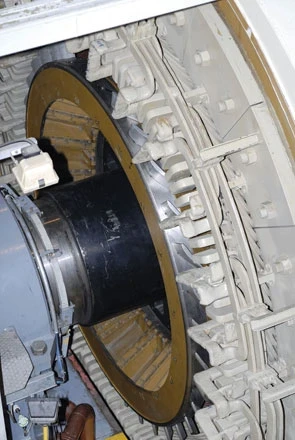
Thermal images are an easy way to identify apparent temperature differences in industrial three-phase electrical circuits, compared to their normal operating conditions. By inspecting the thermal differences of all three phases side-by-side, technicians can quickly spot performance anomalies on...

Maximizing Electric Motor Efficiency

How to get the most from your rotating machines BY STEPHEN MANSFIELD, TechnoWise Inc. An area of great interest is improving the efficiency of electrical devices. More electric motor efficiency means less electrical energy consumed and thus less impact to the environment. By far, the largest...

Reviewing Electric Motor Reliability Research

What did the studies really say—then and now? BY HOWARD PENROSE, Ph.D., CMRP One of the most frequently quoted studies related to electric motor reliability is a 1983 Electric Power Research Institute (EPRI) project, entitled “Assessment of the Reliability of Motors in Utility Applications:...

Motors & Drives

Understanding Short Circuit Motor Contribution

A back to basics approach

BY DARRELL BROUSSARD, GE Industrial Solutions

An electric motor’s contribution is the current generated by a motor or motors during a short circuit condition. It represents a small but important value that is needed to determine the maximum short circuit current available, thereby establishing the short circuit rating of electrical equipment.  Regardless of the size or voltage rating of a motor, it can be demonstrated that motor contribution is present...

Motors & Drives Articles